Blogs
Videos
Commercialising Net Zero Solutions: Lessons from Albotherm
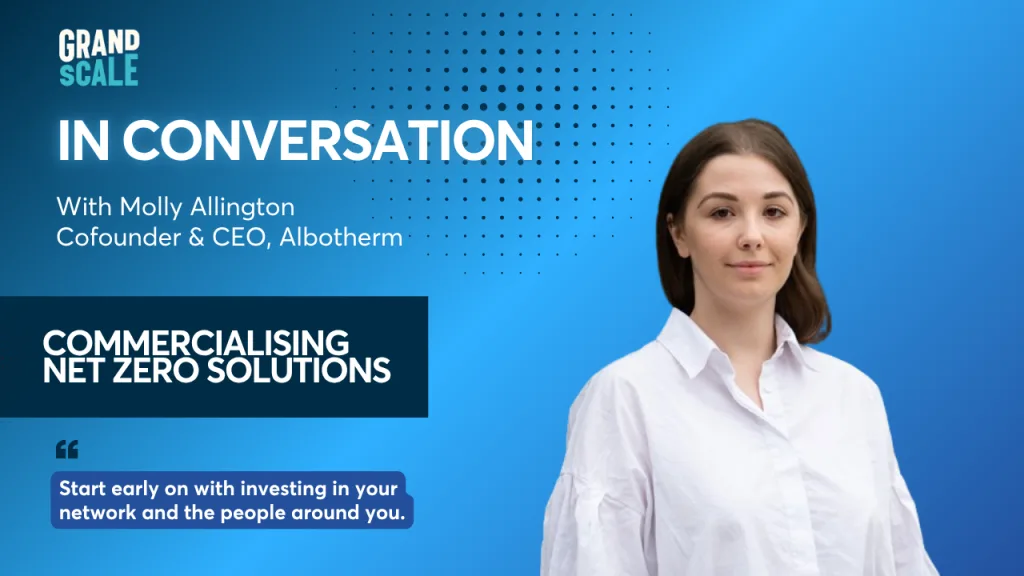
During our recent Grand Scale Ignite programme, we hosted a fireside chat with Molly Allington, co-founder and CEO of Albotherm, a University of Bristol spinout developing innovative cooling solutions for agriculture and the built environment.
A returning Grand Scale alumna and graduate of our Kickstart programme, Molly joined us to share her entrepreneurial journey and offer insights to teams at earlier stages of building their ventures. Since spinning out, she has led Albotherm through early commercial trials, secured public and private funding, and built a growing team focused on reducing carbon emissions in a warming world.
In this conversation, she reflects on what she’s learned so far about identifying the right first market, approaching early customers, working with industry partners, pitching for investment, building team culture, and preparing to scale.
For researchers thinking about commercialisation, or anyone working in climate tech, this is a practical look at what it takes to turn a scientific idea into a sustainable, fundable business.
The Spark to Spin Out
By the end of her studies, Molly knew she didn’t want to stay in the lab. The idea of commercialisation clicked after attending a talk on entrepreneurship for scientists — delivered, fittingly, by someone who would later become a board member at Albotherm.
I knew that I wanted something with a lot of variety. And then someone came and did a talk about entrepreneurship and about how scientists should be getting into entrepreneurship because they have all these amazing skills that can be pivoted, which really spoke to me.
From there, she connected with her co-founder, Dr Sian Fussell who had already started developing the core technology that would underpin Albotherm’s passive cooling solution during her PhD. When they both graduated, they decided to spin out together.
Challenges on the Road to Market
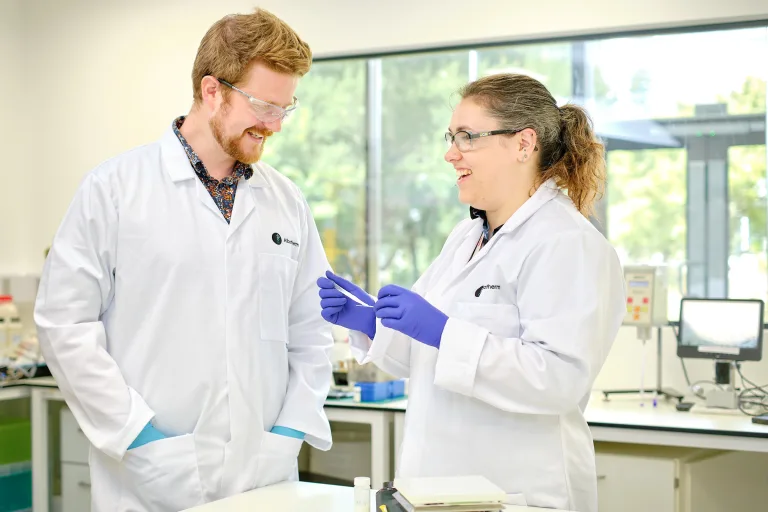
In Albotherm’s early days, Molly says the two biggest challenges were commercial upskilling and raising investment — two areas that were closely connected.
With only two founders, we faced two main challenges: upskilling ourselves to cover every role and securing funding.
Coming from scientific backgrounds, neither founder was an expert in greenhouses or crop production. Learning the market, alongside the language and processes of building a business, required rapid upskilling. Structured commercialisation support, including training delivered by Grand Scale and ICURe, helped the team build this knowledge and confidence.
On the funding side, early grant wins proved vital, eventually helping them secure investment. But Molly stressed that raising capital took time and taught them commercial lessons years before they were ready to sell to customers. “You’re having to value the business and understand how that process works,” Molly explained, highlighting how fundraising accelerated their commercial thinking early on
Misconceptions and Early Lessons
One thing Molly wishes they had done earlier was build a strong advisory board with not just technical experts but also commercial advisors. “We’re starting to put that together now, and it’s really accelerating things for us,” she said. Initially, she assumed experienced advisors would demand high fees but was surprised by “how many are willing to give quite a lot of their time for free just to advise you… with the future promise of payment or with share options… when you don’t have so much cash.”
She also learned that running a startup often looks very different to what founders imagine. “The idea of what I would be doing day-to-day and how it actually pans out is sometimes very different,” Molly reflected. In a small team, that can mean anything from negotiating investment to physically building office furniture — far from the purely strategic role she once pictured.
Identifying and Validating the First Market
Albotherm’s technology is a glass coating that changes from transparent to opaque as temperatures rise, reflecting heat in hot conditions and letting it pass through when cooler.
When deciding where to launch first, Molly spent three months on a market validation programme for university spinouts, conducting over 100 conversations with potential customers. “That emphasis on actually going out and talking to people in the market is really important… it forces you to get very comfortable with cold calling and having those conversations early on.” she said.
The greenhouse industry — which has a serious problem with overheating that can damage crops and is made worse by unpredictable weather — quickly stood out as the beachhead market. There was strong initial interest, the problem was well understood, and growers could easily see this as an improvement over existing solutions. By contrast, entering the buildings sector would require navigating multiple stakeholders, from architects to landlords, and meeting tougher technical requirements around aesthetics and durability. “We felt that market would be better once we’d proved the product and built more of a reputation,” Molly explained.
Approaching Early Customers and Running First Trials
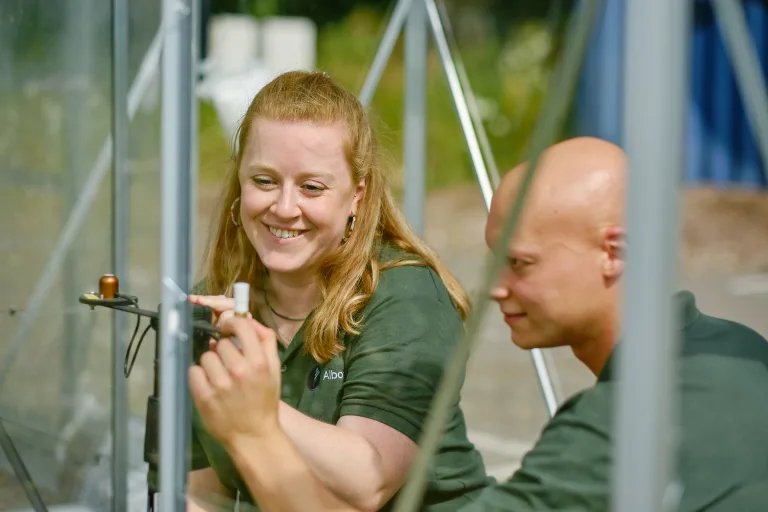
Albotherm’s first commercial trials were with partners they had been in touch with for some time. The key, Molly says, was timing. “The biggest learning was making sure you’re pitching the product at the right stage,” she explained. Some growers were open to the trial-and-error process, while others were less willing to adapt when the application equipment didn’t work smoothly the first time. “Qualifying leads better… would have been really beneficial,” she noted. She adds that uncertainty is part of any trial, and it’s important to communicate that clearly to partners and have mitigations in place.
The trials brought major technical and commercial insights. On the product side, they saw rapid crop growth — in some cases twice as fast — but also found that shading levels needed to be higher during the hottest months. “We could then link that back to a really clear product specification… we need 10% more shading at this temperature,” Molly said. Commercially, the experience helped them map out the full customer journey, from application to removal, and understand how their product interacts with existing climate control systems and day-to-day operations in the industry.
The combination of technical feedback and real-world operational learning helped the team refine both the product and how it’s deployed — a key step toward product–market fit.
Getting Funding and Investment Right
Albotherm has been particularly successful in securing public funding, including multiple Innovate UK and DEFRA grants. Molly’s advice is to apply only where there’s a strong fit. “We’ve avoided some of the bigger, more general funding schemes… because they can be more competitive and quite a struggle.”
She also stresses the importance of having applications reviewed by outsiders.
Try to get people that don’t know anything about the technology, but maybe know the market, or kind of vice versa, to proofread and make sure that you’re evidencing every single thing that you’re putting in.
Grants, she adds, are often “a bit of a tick box exercise” with a structure that gets easier to master over time. Using available support, such as Innovate UK Business Growth or university networks, can also help with grant reviews and feedback.
On investment, Albotherm has completed two rounds, but Molly admits the last one taught them a valuable lesson about timing. They began raising before the company had hit key milestones, leading to months of lukewarm investor interest. “We spent maybe six months talking to people and getting not very far. Then we got results in, one really good investor came on, and everyone else that was a maybe came along very quickly after that.” Her takeaway: maintain investor relationships but save the heavy pitching for when momentum is on your side.
Building a Strong Team Culture
For Molly and her co-founder Sian, culture is central to how Albotherm operates. “We just want everyone to enjoy their work as much as possible, feel fulfilled by it, and feel like they’re being paid fairly.” From a business perspective, it is also essential for innovation. “A good idea can come from anyone in the team… when you get everyone together for a brainstorm, you’d be surprised how much you can get out of that sometimes.”
That openness extends to regular communication and check-ins, making sure everyone understands what is going on and has the opportunity to contribute. Retention is also a practical necessity. Hiring is expensive, time-consuming and disruptive. Keeping people engaged and aligned with Albotherm’s mission helps ensure they are ready to step up during deadlines or big pushes and attracts like-minded talent with diverse skills who can challenge and strengthen decision-making
Wins, Advice, and What’s Next
Molly’s proudest moment so far has been securing a partnership with the market leader in competitor greenhouse coatings. “Getting them to believe in the technology was a real big win… it’s made everything a lot easier with investment, unlocking more funding, and opening doors across the industry.”
For founders considering a spinout, she stresses the importance of patience, persistence, and relationships.
It’s a big commitment, especially for science-based businesses that take a long time to reach market. Speak to as many people as possible, invest early in your network, and build a support system around you.
And for Molly, that support system isn’t just personal — it’s practical too: from accessing mentors and training that helps founders upskill and build commercial capability and confidence, to having the right mix of technical and commercial voices on an advisory board to support the company as it grows.
Looking ahead, Albotherm is scaling up from small R&D runs to medium-scale production, enabling larger trials and first sales. The focus is on getting the product ready for launch and, Molly hopes, signing a major customer deal. “It’s what we’ve all been working towards.”
Explore how Albotherm built commercial capability for growth
In our latest case study, we explore how the Kickstart programme supported Albotherm to build commercial skills, access markets, and secure funding ahead of product launch.
Recent Insights
Supercharge your inbox
Subscribe to our emails for the latest insights and updates