Blogs
Videos
Clean Innovation in Oil & Gas: One Founder’s Road to Market
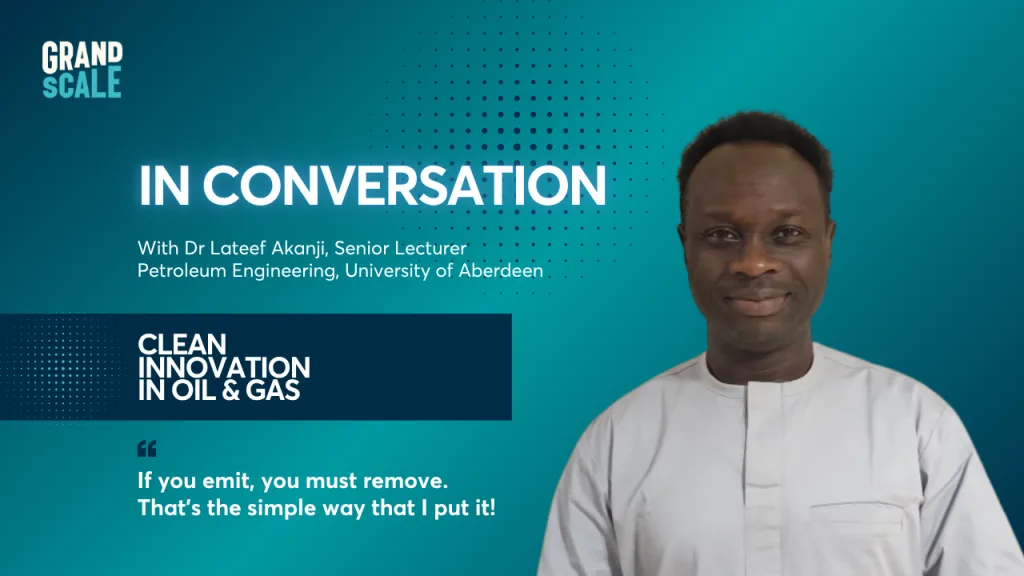
We recently sat down with Dr Lateef Akanji, a 2024 graduate of our Grand Scale Ignite programme, petroleum engineering expert, and academic leader at the University of Aberdeen, for a fireside chat.
Here, he shared his journey and lessons from navigating the commercialisation of two major zero spill and leakage minimisation projects.
Currently at the critical stage between research development and market entry, Lateef offers a unique perspective on what it takes to turn early-stage innovation into a viable commercial proposition. His journey reflects the reality many research-led founders face: balancing academic responsibilities with the time, mindset, and skills needed to prepare for commercialisation and spinout.
From Industry to Academia — and Back Towards Industry
Lateef’s career began in the oil and gas industry, working for Shell and Pan Ocean Oil Corporation before moving into academia almost two decades ago. Reflecting on his motivation to pursue commercialisation, Lateef explained:
“So traditionally, being an active member of the oil and gas industry, it has come to the attention of everyone that we do need to do something differently. We do need to listen to stakeholders, particularly when it comes to discharge of hydrocarbon into the environment. And so I decided to start looking more into research that is very related to net zero.”
Challenging Early Assumptions
When it came to the early-stage challenges of commercialisation, Lateef admitted that his thinking — like that of many researchers — was shaped by long-standing academic habits.
“Prior to the Grand Scale Ignite programme, I’ve always had this assumption that development of new technology is the ultimate. So I spent quite a lot of my time looking at technical things — developing concepts and validating them in the lab, theoretically — with the intention that, oh yeah, that’s what the industry needs.”
Through Ignite, that view shifted.
It became really clear to me that it’s actually far from being the case. Value proposition is key. It’s not just about the technical know‑how — it’s about translating it into something people can use, something that solves their problems and turns their pains into gains.
For Lateef, the realisation that innovation must challenge the status quo — moving people from the way they currently do things to a better way — was one of the most important lessons from the programme.
Communicating Net Zero Without the Jargon
In a global industry like oil and gas, understanding of “net zero” can vary dramatically from one region to another. For Lateef, that makes clear communication a critical part of engaging stakeholders.
The oil industry is a global industry and some countries have well‑established legislation. Some countries have much less and therefore the companies have different ways of thinking about net zero as an example. So it then becomes a bit challenging to translate this idea of what net zero is to companies based on wherever they might be on the globe.
Rather than relying on technical definitions, Lateef distils the concept into a simple, actionable principle:
“If you emit, you must remove. So in other words, if you are discharging something into the environment, you must make sure that you clean it up. And that means equating your emission to your removal. So that’s the simple way that I put it.”
This plain-spoken framing helps bridge the gap between varying levels of environmental awareness and regulation across countries. In some cases, it’s about meeting strict compliance standards; in others, it’s about sparking interest where environmental responsibility has not been a top operational priority.
Reputation can also be a powerful motivator. Lateef has found that major industry actively seek technologies that will strengthen both their environmental performance and their public image. For smaller companies, it’s often about showing them the benefits and letting that message filter up to decision makers.
Validating the Market Gap
Lateef’s first step in validating the need for his research came from listening closely to both industry and government. Many oil and gas operators were being pushed to take greater responsibility for pollution and spillages, while governments were making it clear that change was needed.
“I quickly noticed that there’s a gap in here that I think I can bridge by contributing through my research.”
Conversations at conferences and networking events reinforced this, with stakeholders openly calling for solutions to reduce spillages. Interest also came directly from companies reaching out after discovering his work online or through the university’s research and innovation team. These interactions confirmed that his work could be developed into something with real commercial potential.
Navigating Funding and Investment Conversations
For Lateef, the Ignite programme reshaped how he thought about funding and investment — not just as a means to finance research, but as a strategic part of building a sustainable venture.
“Every company or customer will always like to see value before they can commit to any project. Even if it’s fascinating or brilliant, they will always want to tie it to a value. Without that, committing funds to anything is very, very difficult.”
Alongside identifying the right value proposition, Lateef stressed the importance of exploring different funding avenues — from local university grants to government programmes, venture capital, and crowdfunding — while being careful about the terms.
You do not trade your equity for money. Always negotiate for non‑dilutive funds that may help you sustain your project for a very long period of time. And also, because funding is always a very considerable part of commercialisation, start small and then develop slowly.
His final advice was simple: secure non‑dilutive options first and only consider equity funding once other avenues have been exhausted — because once equity is given away, it’s gone for good.
Deciding on the Route to Market
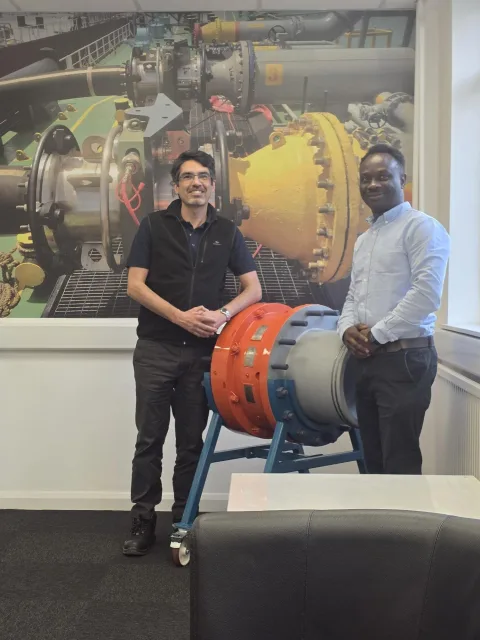
For Lateef, the process of bringing his technology to market is closely tied to funding and scalability. He is currently preparing two technologies for market entry, each at a different stage of readiness.
The first builds on an existing TRL 7–8 product already in use, adapted for stricter environmental requirements in offshore operations. The second — a gas leakage technology developed from the lab — is now fully tested and validated, and ready for its next phase.
“We’ve had a couple of investors asking to take the technology into their business. This is where the skill from Ignite is helping me — from our side, we feel licensing could make it available to a wider base of customers. We’ve not yet decided, as it all comes down to funds and investment capital.”
Scaling in the oil and gas sector presents a major hurdle. As was noted in the discussion, many university‑born technologies work at gram scale in the lab but require substantial capital to scale to the kilogram or tonne scale that industry demands. This is often where feasibility challenges arise, even if desirability and viability are clear. Sometimes it may require a licensing approach initially to build revenue before you can become a manufacturing or product business.
Lateef agreed, noting the capital‑intensive nature of the industry and the time required to finalise scalability.
Proving Compliance on the Path to Market
When asked how he demonstrates compliance with regulatory and industry standards, Lateef explained that this starts at the design stage.
“When we design things, we have to be compliant with the design specification as well as codes of practice in engineering design. For instance, we can talk about API standard, we can talk about ISO standard… whichever one we apply. If we say this material is not going to fail or is not going to leak, we have to say that by this standard we’ve been able to demonstrate compliance.”
This continues through physical testing — from lab models to larger‑scale trials in industry facilities — with each stage moving the technology to a higher TRL.
“It’s a journey,” Lateef said. “We move stepwise, making sure we pass compliance checks at every stage.”
Advice for Academics Moving Towards Commercialisation
When asked for his top advice to researchers considering commercialisation, Lateef was clear: start with the market gap.
Every business is born out of a gap in the market — discovering this and how to bridge the gap is critical. Think more about value proposition… it is really, really critical.
He encouraged researchers to make the most of local resources, explore business models and market strategies early, and have a clear plan for how a product will reach its market.
“Once you have this product, think about how you develop it and link it to the market. And more importantly, think about the source of funding from the outset — because you don’t want your great idea to stay in the lab for a very, very long time.”
Acknowledging that the journey can be slow and daunting, Lateef emphasised the importance of resilience.
“It certainly is a roller coaster. You’ve got to be really determined — I’m going to get there, I’m going to do it. With that motivation, barriers will clear over time.”
Watch the Full Conversation
We’ve covered some of the key moments from Lateef’s journey above — but there’s much more in the full fireside chat.
Recent Insights
Supercharge your inbox
Subscribe to our emails for the latest insights and updates