Blogs
Backing women-led businesses makes sense. The capital is committed. What next?
What’s needed now is a pipeline of women-led ventures built to scale from day one.
By Roisin Garland, Co-Founder, Grand Scale
Through the Invest in Women Taskforce, more than £635m is now committed to backing women-led businesses. But capital can only back the ventures in front of it, and the pipeline of women-led businesses built to scale is far too thin.
Investor-ready ventures aren’t made in the pitch room. They’re made much earlier, when a founder first sees her idea could scale and gains the capability and confidence to build it that way.
Investors don’t back slides. They back proof. Early on, that means a credible plan and a team convincing enough to deliver it.
I’ve worked at the coal face of growth and sat on every side of the table: more than 25 years driving international expansion for technology companies through scale-up and acquisition and investing as an angel. Together, Leanne Jennings and I bring more than 50 years’ experience between us, and we’ve built Grand Scale, a women-led business with one focus: building commercial capability in innovation ventures, from concept to scale-up. We’ve supported more than 150 ventures so far, across the UK and Ireland.
That work has taught me one thing above all: a venture isn’t investor-ready until it’s commercially ready. And commercial readiness starts at the earliest stage.
That means de-risking the innovation, the business model and the team: proving real customer need and unit economics, building a growth strategy where each milestone unlocks the next step up in value, and showing you have the team to deliver it. Do that, and the risk is mitigated one milestone at a time. That’s what convinces customers, partners, funders and investors. Skip it, and a pitch is just slides.
The readiness gap isn’t unique to women. Plenty of founders, men included, have a polished deck long before they have a strategy, or a team, to deliver it. The difference is who gets the support, networks and capital to close that gap. As the evidence below shows, too often it isn’t women.
Where capital is deliberate, the gap closes
The case for backing women-led businesses is clear. When BCG analysed startups from the MassChallenge accelerator, women-founded businesses received less than half the funding of male-founded ones, yet generated 10% more revenue over five years: 78 cents for every dollar invested, against 31 cents.
That case is now being backed with real money. Alongside the Taskforce’s commitments, the Women Backing Women Fund of Funds reached a £130m first close in March 2026, and the British Business Bank’s £400m Investor Pathways Capital targets at least half its investment to women fund managers.
And it’s working where people act deliberately. Signatories to the Investing in Women Code directed 32% of their venture capital to teams with at least one woman founder in 2025. Across the wider market, the figure was 15%. All-female founding teams received just 2%.
The Taskforce’s own manifesto names the next risk: high-potential women-led businesses are “often lost early in the journey”.
As this capital goes looking for women-led businesses to back, will it find enough with the commercial proof investors need, and will it see them in time?
The pipeline leaks long before the pitch
Read the major reviews side by side (the Invest in Women Taskforce manifesto, the Scottish Government’s Pathways review, the Global Entrepreneurship Monitor and the European Commission’s 2026 report) and one pattern stands out. Women start businesses. But too few are built to scale from the start, and the pipeline leaks between the first idea and the scalable business, exactly where commercial capability has to be built.
- Women start, but fewer scale. Roughly seven women start a business in the UK for every ten men. Fewer go on to build high-growth companies: fewer than 8% of UK spinouts have all-women founding teams, and across the EU, 74% of women entrepreneurs work solo, against 66% of men.
- When capital arrives, it arrives smaller. In 2025, UK teams with at least one woman founder took part in 25% of equity deals but received only 15% of the money invested.
- Support thins out where it matters most. Women with plans to start a business are less likely than men to actually launch one, and in Scotland, 77% of women founders surveyed said signposting and pathways weren’t good enough.
- Time is a structural barrier, not a personal one. In the EU, one in four women entrepreneurs works part-time, against roughly one in ten men. Globally, women are around 50% more likely than men to close a business for family or personal reasons.
- The confidence gap is real. The talent gap isn’t. In the EU, 42% of women believe they have the skills to start a business, against 55% of men. Yet women entrepreneurs there are better qualified: 48% have tertiary education, against 34% of men.
- Networks decide who gets seen. Women make up just 14% of UK angel investors and 23% of senior venture capital roles. Women angels put 49% of their money into women-led businesses; men put in 19%.
The pipeline is invisible. Every one of these reports calls for better data. Today, few can say with confidence where women-led ventures are on their growth journey, what is holding them back, or what support actually works.
What if women founders were never the problem?
Organisations across the Taskforce’s network, and programmes such as Innovate UK’s Women in Innovation, have done important work building confidence, networks and visibility for women founders. But there’s a trap our whole sector can fall into: quietly treating the founder as the problem.
The evidence points elsewhere. The Pathways review warns against assuming “the problem rests with the entrepreneurial capabilities of women themselves”, and against “adding to broken systems instead of fixing them”. Women entrepreneurs are, on average, more highly educated than their male peers.
What they too often lack is access: to the right commercial skills from the earliest stage, to support that fits around real lives, to warm routes into capital, and to a credible way of evidencing what they can do.
So the question isn’t “how do we make women more investable?” It’s “how do we help women-led businesses build the commercial proof that makes them investable, and make sure investors see it?”
None of this lets the investment side off the hook. Bias in who gets backed is real, and the Taskforce’s work on it matters. But capital and commercial readiness must move together.
What commercial readiness looks like in practice
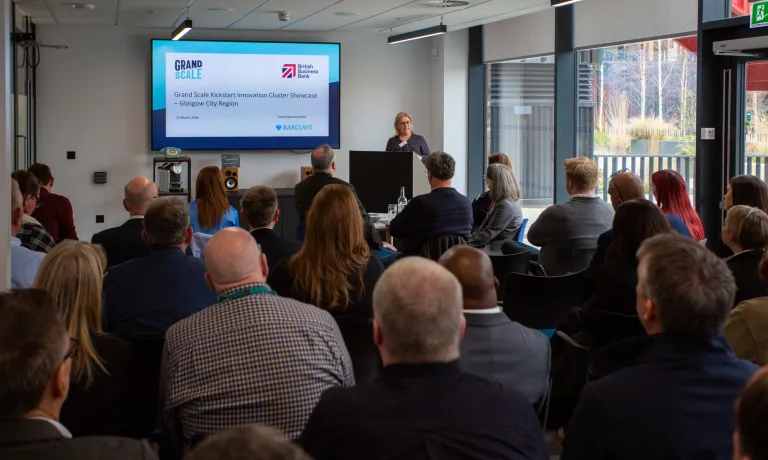
From Grand Scale Ignite, working with research teams at the very earliest stage, to Grand Scale Kickstart, taking ventures to market and investment, our programmes aren’t women-only. But Leanne and I designed them around the realities we lived as women scaling companies.
Leanne was part of the team at Kainos for a decade as it scaled from SME through IPO to unicorn status. I’ve driven international growth through multi-million-pound acquisitions. We’ve both done it often as the only women in the room, while building careers around young families. And Grand Scale is itself a women-led business, so the barriers in this blog aren’t research to us. We still navigate them every day, and they shaped every design decision we made.

Grand Scale co-founders Roisin Garland and Leanne Jennings with angel investor Les Gaw at Eagle Labs, Glasgow, following the Kickstart investor showcase.
In practice, that comes down to these principles:
- We start with validation. Founders test their business model with real customers and prove the unit economics before anything else.
- We build the growth strategy. Go-to-market, sales pipeline and pricing, mapped to the milestones that unlock value.
- We build the team and the engine. The skills and internal infrastructure to win customers at scale. Up to four people from each venture take part, so it’s the team that grows, not just the founder.
- Then we prepare for investment. Investor readiness comes last, built on proof, with investor sessions led by active angels and introductions through our alumni network. Confidence follows competence.
- We built it for real lives. Digital-first delivery, recorded sessions and live coaching that fits around caring responsibilities and day jobs.
- We measure it. Every founder completes a baseline and a post-programme assessment, so progress is evidenced, not assumed.
The results show why the order matters. Across six national cohorts for Innovate UK’s ICURe programme, 75 spinouts from 27 universities took part. Within around 12 months, 75% of surveyed spinouts had won new sales or contracts. Traction and investment went together: 56 of the 75 secured funding or investment totalling more than £82m. Our analysis puts the return at £33 for every £1 of public investment. Our British Business Bank pilot in the Glasgow City Region recorded self-assessed commercial capability uplifts of 80–143%.
Women made up 34% of Kickstart for ICURe participants, and 39% of the 350+ research and technology leaders we’ve trained across all our programmes.
One honest caveat. These outcomes come from mixed-gender cohorts, and we don’t yet report them by founder gender. We should. That gap is exactly what we’re now working to close.
You can’t back what you can’t see
The Taskforce is right to push for transparency on how capital flows: who invests, and where the money goes. The other half of the picture is the pipeline itself. That’s why we’re building a new AI-enabled delivery and measurement platform to sit underneath our programmes.
For founders, it brings the programme, tools and support into one place and shows their progress over time. For funders and investors, it gives an evidenced view of a cohort: where ventures start, where they get stuck, how they progress against the milestones that de-risk investment, and what follows in customers, revenue and capital raised. Every data point will be traceable to its source. It won’t replace anyone’s readiness framework; it will be the evidence layer beneath them. Transparency on the money, matched by evidence of which ventures are commercially ready to receive it.
The capital is ready. Is the proof?
The UK has done the hard work of putting capital on the table for women founders. With £250bn of potential value for the UK economy at stake, the risk now is a mismatch: capital ready to deploy, and too few ventures visibly ready to absorb it. Closing that gap is a shared job.
The talent is there, and so is the ambition. We see it in our own alumni: Dr Stavroula Kapoulea, COO and co-founder of quantum spinout Kelvin Quantum, has gone on to win a £1.65m UKRI Future Leaders Fellowship. What’s needed is a system that creates many more stories like hers: one that builds commercial readiness first, evidences it, and puts it in front of the right investors at the right time.
That’s where we want to help. If you lead a women-led angel syndicate, manage a fund backing women founders, run a university spinout or founder programme, or shape policy in this space, I’d love to compare notes. You’re building the routes for capital. We want to make sure the ventures arriving at them are commercially ready, not just pitch-ready.
Sources: Department for Business and Trade, Investing in Women Code annual report (July 2026); Invest in Women Taskforce, Manifesto 2026; Invest in Women Taskforce, Women Backing Women Fund of Funds first close (April 2026); British Business Bank, Investor Pathways Capital (2025); Invest in Women Taskforce, Beauhurst and UKBAA, Women Angel Investors (2025); Level 20 and BVCA, Diversity in UK Private Equity and Venture Capital (2025); Royal Academy of Engineering and Beauhurst, Spotlight on Spinouts (2025); Stewart & Logan, Pathways: A New Approach for Women in Entrepreneurship (Scottish Government, 2023); GEM UK 2024/2025 National Report; GEM 2024/2025 Women’s Entrepreneurship Report; European Commission (EISMEA), Women Entrepreneurs in Europe (2026); BCG and MassChallenge, Why Women-Owned Startups Are a Better Bet (2018); The Alison Rose Review of Female Entrepreneurship (2019); Grand Scale programme impact data.
Recent Insights
Supercharge your inbox
Subscribe to our emails for the latest insights and updates