News
Commercial capability at the heart of place-based growth
The UK does not have an innovation problem. It has a conversion problem.
If the UK is serious about growing its industrial base and raising productivity in every part of the country, the investment case cannot stop at infrastructure and capital. A decade of investment has built the pipeline — universities, research institutes, technology transfer offices, incubators and innovation districts — and a substantial wave of place-based finance is now following it, through the British Business Bank, the National Wealth Fund, Local Growth Plans and pension reform.
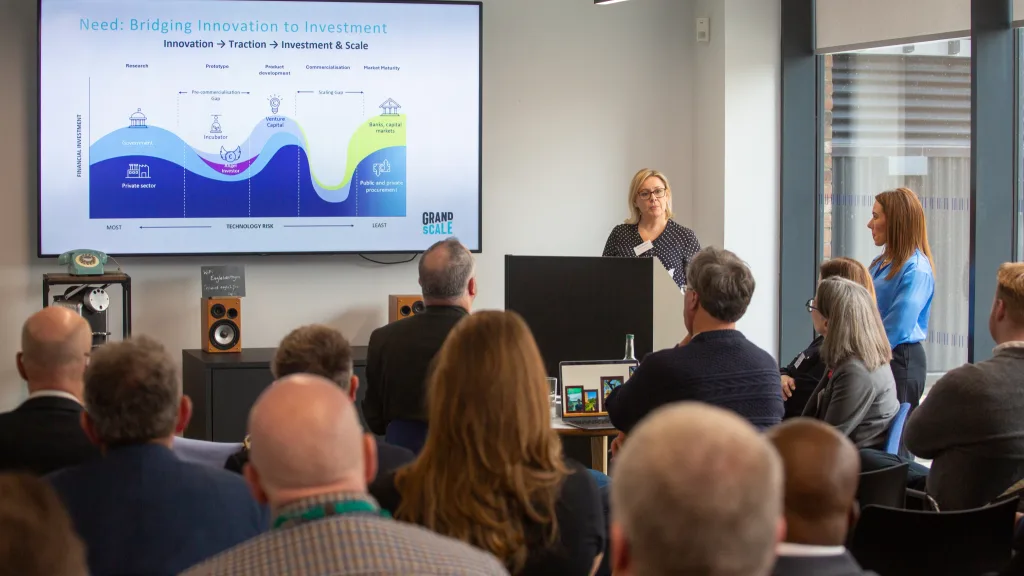
Almost all of it sits on those two sides. What decides whether any of it converts into companies, customers, jobs and value that stay in place is a third and much thinner layer: the commercial capability to turn research and technology strength into businesses that sell, raise growth capital and scale where they started.
That question ran through a three-part roundtable series hosted by Metro Dynamics at June's inaugural UK Global R&D and Science Investment Summit. Around ninety leaders took part across the three connected conversations — from government, universities, industry, investment, local and regional institutions and innovation ecosystem organisations — including our co-founder Roisin Garland.
The sessions were chaired by Professor Dame Jessica Corner, Executive Chair of Research England; Stephen Jones, Director of Core Cities UK; and Tom Walker, Executive Director of Policy, Economy and Investment at Essex County Council, and were hosted by Fiona Tuck of Metro Dynamics with independent advisor Emma Lindsell. The brief was deliberately practical: how national policy intent becomes local growth, in county economies, smaller cities and rural areas as much as in the established innovation cities.
The report from those discussions has now been published, and the proposition at its heart is bracingly plain:
Ultimately, the purpose of innovation policy is not to create projects, programmes or institutions. It is to create the conditions in which businesses can create value for customers, grow and invest - because this is what drives economic growth.
Metro Dynamics Report, 2026
Outcomes, front and centre
The first of the report’s three headline messages is about what the system counts. "We measure funding allocated, programmes launched, buildings opened and businesses supported," it notes, "but spend much less time understanding whether those interventions are genuinely changing commercial behaviour or improving long-term economic performance." What places need instead is a clearer view of "whether ideas, businesses and opportunities are moving through the system towards customers, investment, growth and wider socio-economic value" — what the report calls innovation throughput. And the leading indicators that would show this early enough to act on are, as it puts it, rarely developed.
The layer under strain
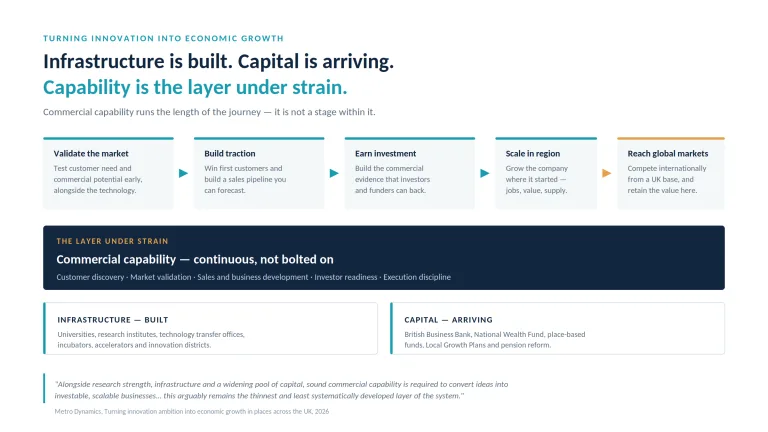
So what decides whether ideas make that journey? The report is direct about it:
Alongside research strength, infrastructure and a widening pool of capital, for innovation to be the means for an economic growth end, sound commercial capability is required to convert ideas into investable, scalable businesses. The discussions reflected that this arguably remains the thinnest and least systematically developed layer of the system.
Metro Dynamics Report, 2026
It goes further, naming execution capability as "now the UK’s scarcest innovation resource" — the venture builders, ecosystem orchestrators, cluster leaders, commercial translators, investment curators and partnership brokers who turn a decade of strategies, programmes and physical assets into outcomes.
The last decade wasn’t wrong. Places built the runway — the incubators, the spinout pipelines, the cluster strategies. That was the right work. But the constraint has moved downstream, to conversion: turning that supply into companies that win customers, raise growth capital and scale where they are. Infrastructure and finance got built because they’re scalable — buildings, funds, programmes. Commercial capability is the least scalable part of the system, which is exactly why it keeps getting treated as a soft extra rather than the infrastructure it is.
Roisin Garland, Co-Founder, Grand Scale
The report’s practical implication is set out without hedging. The system needs to move "from creating businesses to creating commercially successful businesses", which means "proof of market and proof of customer should sit alongside proof of concept, with sales, business development, procurement and commercial execution brought much earlier into the innovation support system." Success, it argues, "is not just about generating more innovation ideas; it is identifying the strongest opportunities faster, failing others earlier and backing the best harder."
What we see in delivery
That matches what we see, and the wider evidence points the same way. Only around one in eight UK startups that raise a seed round ever goes on to raise a Series A, according to Antler’s analysis of more than 41,800 UK funding rounds. These are companies that have already cleared an investor bar once — which makes the stall at the next step a conversion problem, not a shortage of capital.
The independent review Beyond the Capital Gap found the most common cause of failure at that step to be the absence of experienced commercial leadership rather than weak technology, and that 69% of UK research power sits outside the Golden Triangle while those regions attracted just 15% of spinout venture capital since 2010. The same gap appears in the Entrepreneurs Network's Ideas to Impact report and in Tony Hickson's independent review for UKRI Research England, Deepening University–Investor Links. As Hickson put it, capital alone is not the answer, and simply throwing money at unprepared founders will be futile.
There is a timing problem too, and it is one we see repeatedly: structured support tends to fall away at the moment a company is formed, exactly when market traction, leadership confidence and investor alignment decide who survives.
Built for that gap
Grand Scale Kickstart features as one of the report’s case studies, described as "a useful example of the kind of commercialisation support that places increasingly need":
Its Kickstart programme works with research and technology-led ventures, from pre-spinout research teams through to scaling companies, to validate markets, secure customers, build sales pipelines and prepare for investment. Rather than treating customer discovery, sales, investment readiness and scale-up as later-stage activity, the model brings those disciplines into the process of venture development from the outset.
Metro Dynamics Report, 2026
That is the gap it was built for, and it is where we have worked for over 6 years — across 160+ ventures and 330+ founders and senior leadership team members, with 33 universities. Delivered nationally for Innovate UK’s ICURe programme across 75 spinouts and 27 universities, Kickstart is recognised by the ScaleUp Institute as an exemplar national programme and generated what the report describes as "a reported 33:1 return on public investment". The underlying figures, reported by participating ventures within approximately twelve months, include £7.8m in early commercial revenue and £82.4m in follow-on funding. Notably for a place-based agenda, 65% of those spinouts came from outside the South of England and they accounted for 68% of reported investment — an association we would be cautious about reading as causation from a self-selected cohort, but a markedly more balanced distribution than the wider spinout picture.
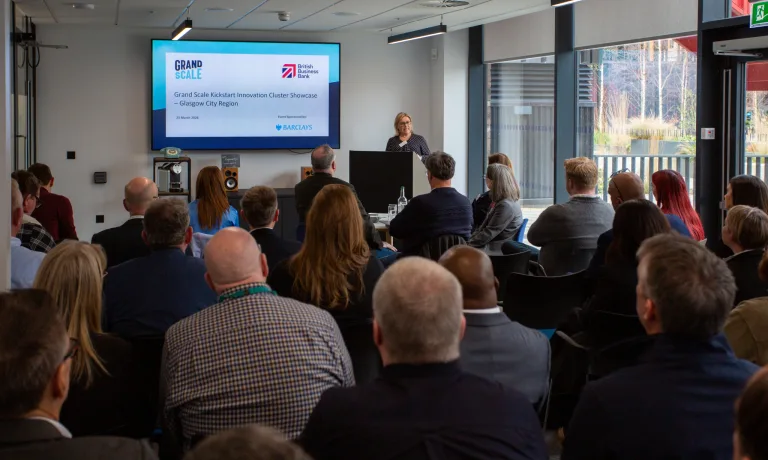
The report also picks up the city-region application of Kickstart: "a ten-week pilot for the British Business Bank in Glasgow City Region which brought ventures from four universities into a single investment-ready pipeline." That last phrase is the part worth dwelling on. Ten ventures and twenty-two founders came through it, and the signal that mattered most was not ours to give: an independent panel of active UK early-stage investors judged the cohort investment-ready, and three of the ten moved into immediate follow-on conversations. Find out more here.
But the wider value was to the actors around them — universities, investors, local government and the economic development agency — who for the first time shared a single view of the pipeline they are all working with.
That speaks to something the report describes well:
Innovation ecosystems are inherently complex, involving many organisations with overlapping roles and responsibilities. The challenge is not to simplify that complexity, but to provide sufficient signposting, distillation, clarity, coordination and focus that the right people come together around the right opportunities at the right time, with agency and purpose.
Metro Dynamics Report, 2026
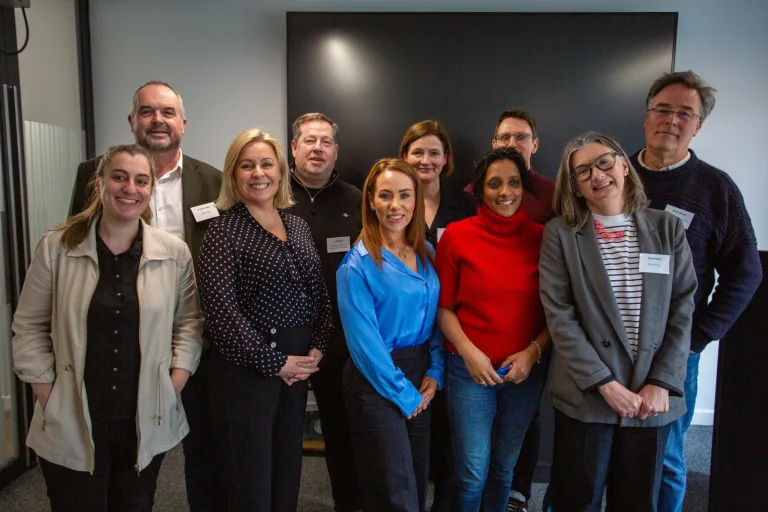
Seven organisations, one shared goal. Grand Scale was joined by Eos Advisory, Equity Gap, Gabriel Investment Syndicate, the UK Innovation & Science Seed Fund, British Business Bank and Barclays Eagle Labs at our Innovation Showcase, bringing together the support, capital and expertise founders need to scale.
Capability as infrastructure — and not only for spinouts
The line we would most encourage people to sit with is this one: the report prompts "the need to consider the commercial capability of a place as an important part of its infrastructure" — "not only about individual programmes or interventions, but about the people, networks and know-how that help businesses understand markets, find customers, raise finance, navigate growth and learn from others who have done it before."
The report is also right that this is a broader agenda than spinouts. It names as one of the biggest blind spots in the current innovation agenda the fact that policy is largely designed around newly formed businesses, founders and spin-outs, with comparatively little attention paid to established firms, supply chain companies and businesses now led by people who were not their founders — particularly in industrial, rural and non-metropolitan economies.
Our own work already spans more of that range than the spinout headline suggests. Kickstart is delivered to startups and scaling companies as well as research spinouts, and the Glasgow cohort alone ran from pre-spinout teams through to companies already selling. The disciplines don’t change along the way. Validate the market. Understand the customer. Build a pipeline you can forecast. Earn the investment rather than pitch for it. Those aren’t the property of spinouts, and they don’t stop mattering once a company is ten years old or was founded by someone who has since handed it on. The report’s challenge — to bring established and supply-chain firms deliberately into the innovation agenda — reaches further still, and it is the right challenge.
The competition is not between regions
There is one more reason to treat this as shared infrastructure rather than local advantage. Stephen Welton, Chair of the British Business Bank, has warned that the UK risks becoming an "incubator economy" that "builds up new companies only for them to be sold off to overseas buyers or left to wither on the vine." That is a value-capture problem, and no single region solves it alone.
The report arrives at the same place from a different direction, through what it calls "complete, not compete" — the logic behind the Cambridge × Manchester and Oxford–Liverpool partnerships, which it describes as "attempts to retain more of the research translation and commercial value chain within the UK." Collaboration, it argues, "should not be seen as an alternative to scale, but as one of the mechanisms through which scale is achieved," with places of all kinds increasingly needing to "hunt in packs."
The regions aren't really each other's competition. The competition is external — the acquirer, the relocation, the round led from somewhere else. Treating commercial capability as shared infrastructure doesn't dilute anyone's USP: a place's advantage is its science, its industrial base, its people, and none of that is affected by agreeing how commercial execution capability is built and readiness is measured.
What shared infrastructure does is give ventures a clearer pathway to build capability and demonstrate readiness, while making regional strengths visible and comparable — so partners can refer with confidence, investors can recognise trusted signals, and the system sees one coherent pipeline rather than thirty bespoke ones. That's something the system should own collectively, not something any one provider should lock up.
Roisin Garland, Co-Founder, Grand Scale
The shift worth watching
The encouraging signal in this report is how firmly the argument has moved. "Over the last decade, many places have invested heavily in physical innovation assets," it observes. "The next challenge is to wrap systems around them." Buildings remain important, but they are no longer enough. The same logic applies to capital: the report’s closing section argues that places need "to become more investable, not just better at attracting investment", that developing an investable pipeline "requires significant commercial capability", and — a line worth pinning up — that "investors are customers too."
Investors, the report notes, "are not simply looking for long lists of projects or broad statements of sector strength; they are looking for opportunities that have been tested, shaped and de-risked."
Capability, in other words, is not an alternative to capital or to infrastructure. It is what makes both of them convert.
There’s a real wave of place-based capital arriving in the regions, and almost all of it sits on the capital and infrastructure sides. If we don’t resource the capability layer alongside it, we risk deploying more money into ventures that still can’t convert it. The attraction is that capability is a force multiplier — it makes the money already in the system work harder, rather than asking for more.
Roisin Garland, Co-Founder, Grand Scale
We’re pleased to have contributed to the discussions behind the report and look forward to continuing the conversation and working with partners to translate innovation potential into growth across all parts of the country.
About Grand Scale
We build the commercial capability and intelligence that de-risk innovation for the people backing it — funders, customers, partners and investors — turning research and technology potential into commercial evidence, investability and scalable companies.
Our frameworks have been applied across 160+ ventures and 330+ founders and senior leadership team members, with 33 universities. Kickstart is recognised by the ScaleUp Institute as an exemplar national programme.
Turn innovation potential into companies that sell, raise and scale.
Sources: Turning innovation ambition into economic growth in places across the UK, Metro Dynamics Ltd, 2026. Stephen Welton, "The British Business Bank is a partner for the scale-up economy", City AM, 22 January 2025. Additional figures: Antler, The New Path to Series A in the UK, 2026; Beyond the Capital Gap, Henham Strategy for Pioneer Group & The Crown Estate, March 2026; UKRI, Deepening University–Investor Links. Kickstart outcome figures are reported by participating ventures; Glasgow City Region pilot delivered with the British Business Bank, January–March 2026.
Recent Insights
Supercharge your inbox
Subscribe to our emails for the latest insights and updates