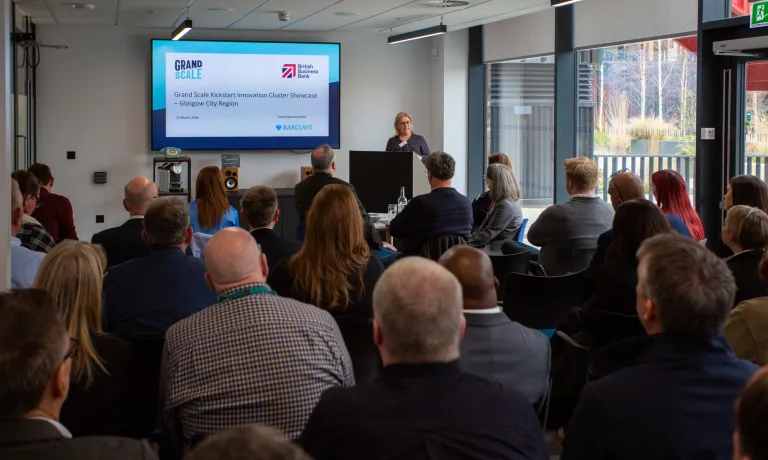
WaveCAD pitches to a panel of active early-stage investors at the Glasgow City Region Kickstart Innovation Showcase.
Blogs
Scaleups Are Built From the Ground Up
By Roisin Garland, Co-Founder, Grand Scale
For programme directors, investment leads, and place-based economic development leads, success isn't measured by how many ventures you support. It's measured by how many go on to generate revenue, attract investment, and scale. The challenge is also seeing how that journey is progressing across a whole portfolio, not just through a handful of success stories.
In this article, we'll explore why these barriers take root long before a venture reaches scale, what we've learned from working with founders across the UK, and why we believe commercial capability is the missing layer connecting innovation with growth.
The scaleup gap starts at the idea stage
Every year, the ScaleUp Institute's Annual Review reminds us that the UK is good at starting companies but less so at scaling them. The same three barriers keep coming up: access to markets, access to finance, and access to talent, particularly leadership capability.
As this year's Review approaches, we want to make a simple argument. Successful scaleups are built from the ground up. The capabilities that unlock markets, capital and leadership aren't acquired at Series A. They are built years earlier.
Three barriers, one root cause
We tend to treat these barriers as scaleup problems. In practice, they take root at the very start of the venture journey.
- Markets. A team that has never run structured customer discovery reaches its first sales conversation without a clear customer, value proposition, or route to market.
- Finance. Investors back evidence of commercial traction and a team that can execute. Ventures that arrive without either of these often struggle, however strong the science.
- Talent and leadership. Founders from research backgrounds rarely get the chance to build commercial leadership skills before they need them.
The common thread is commercial capability, which underpins access to markets, improves access to finance, and develops leadership confidence and effectiveness.
Metro Dynamics' recent report, Turning Innovation Ambition into Economic Growth in Places Across the UK, finds that alongside research strength, infrastructure and capital, commercial capability "arguably remains the thinnest and least systematically developed layer of the system."
Building commercial capability from day one
For six years, Grand Scale has focused on developing commercial capability from as early as TRL 1. The goal is progressive de-risking: each stage leaves ventures commercially stronger and better equipped to win customers, partners and investors, and to scale globally from wherever they are based.
Our programmes form one continuous pathway:
- Grand Scale Ignite works with university research teams with ambitions to spin out, at the earliest concept stage. It equips teams to test whether there is a market worth pursuing, identify the best route to market and shape how to approach funders and investors. Teams move quickly to the right next step: further funding and support, venture creation or, just as importantly, a clear decision not to progress. At the same time, it de-risks teams for public funding.
- Grand Scale Kickstart builds the commercial capability to launch, grow and scale globally. Teams create a commercial strategy for growth and the sales and marketing engine to execute it: strong go-to-market foundations, repeatable sales processes, and an international pipeline. That capability carries ventures from commercialisation through launch, sales traction and international expansion, de-risking them for private investment along the way.
- Investment Readiness and Enterprise Sales work together to drive scale. Enterprise Sales builds an end-to-end process for converting that pipeline into closed deals, proving the opportunity through real traction. Investment Readiness turns that traction into a compelling case for capital, so teams can raise the funding to scale operations and meet demand.
Scaling is a chicken-and-egg problem. Companies need capital to scale operations and meet demand, but investors need to see sales traction before they release it. Building sales capability and investment readiness together breaks that cycle. Ventures can show investors a real, growing opportunity and secure the funding to capture all of it.
Each stage builds on the last. Ventures don't start again at every funding gate. They arrive with evidence, skills and momentum.
The evidence: proven nationally
Through Kickstart, which we delivered as part of Innovate UK's ICURe programme (2022–2025), we worked with 75 spinouts from 27 universities. They were drawn from a decade of ICURe alumni, split roughly evenly between pre-revenue ventures and established, trading companies.
Together, they went on to secure £82.4m in follow-on funding and investment and generate £7.8m in early revenues within around 12 months.* All of this came from £2.736m of public investment: a reported 33:1 return in economic value.
The commercial outcomes were just as strong. Within around 12 months,* 79% had launched or were on track, 75% had secured new sales or contracts, 62% had expanded internationally and 75% had secured funding and/or investment. These results are the clearest measure of leadership capability. The programme supported 182 founders and leaders, 34% of them women, and the impact of that capability development was reflected in customers won, markets entered and capital raised.
Where that capital went matters just as much. 66% of the ventures that raised funding and/or investment were based outside the South of England.
Capital follows commercially strong pipelines, regardless of postcode.
Delivering ICURe also showed us where support needed to start earlier. Commercial opportunity exists on every entrepreneurial campus, including universities with smaller commercialisation teams, but too often it goes undiscovered. We used that experience to develop Ignite, so research teams build commercial evidence and test the opportunity before they spin out.
Last year, the ScaleUp Institute recognised Kickstart as an exemplar of good practice.
*Measurement timing varies by cohort.
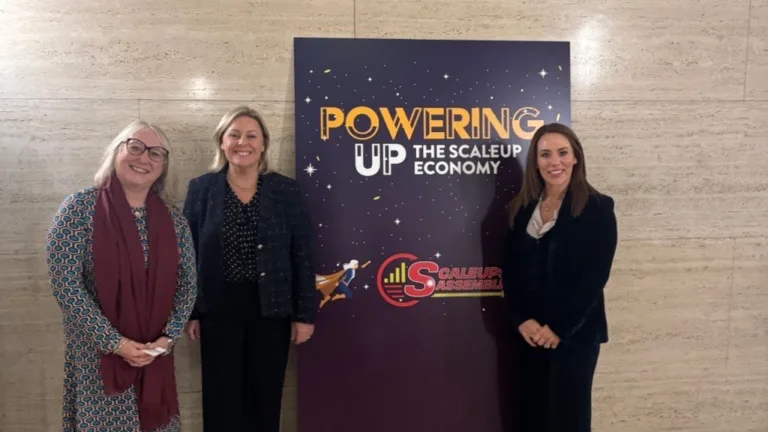
Pictured (left to right) Irene Graham OBE, CEO & Board Director, ScaleUp Institute, Roisin Garland and Leanne Jennings , Grand Scale Co-founders
Replicated regionally: Glasgow City Region
Earlier this year, we tested whether the same approach could work at regional level. With support from the British Business Bank, ventures from four Glasgow City Region universities came together in a single investment-ready pipeline.
A panel of active early-stage investors assessed the cohort's investment readiness at our closing showcase. You can view the investor panel's reactions here. Every team made valuable investor connections, and three moved straight into follow-on discussions. Founders' self-assessed capability improved by 80–143% across the areas we measured.
Metro Dynamics subsequently featured the Glasgow City Region programme as a case study in its work on innovation-led economic growth.
One founder's journey: SeizureVue
SeizureVue, a Glasgow Caledonian University venture, shows what happens when the ecosystem works together. Backed by the university, Professor Hadi Larijani started with Grand Scale Ignite at pre-spinout stage. UKRI followed with £250k of Proof of Concept funding and Scottish Enterprise with its High Growth Spinout Programme, before Kickstart took the team through commercialisation to our investor showcase.
Each partner made the next step possible, and the team built its commercial and investment readiness skills before it needed them. Even at seed, they could see the path to Series A, marrying product, regulatory, partner and investment strategy with a commercial strategy for accelerated growth. That's why shared ecosystem infrastructure matters: infrastructure that builds commercial capability venture by venture and makes progress visible across whole portfolios, so every partner can make better decisions and see how their investment contributed.
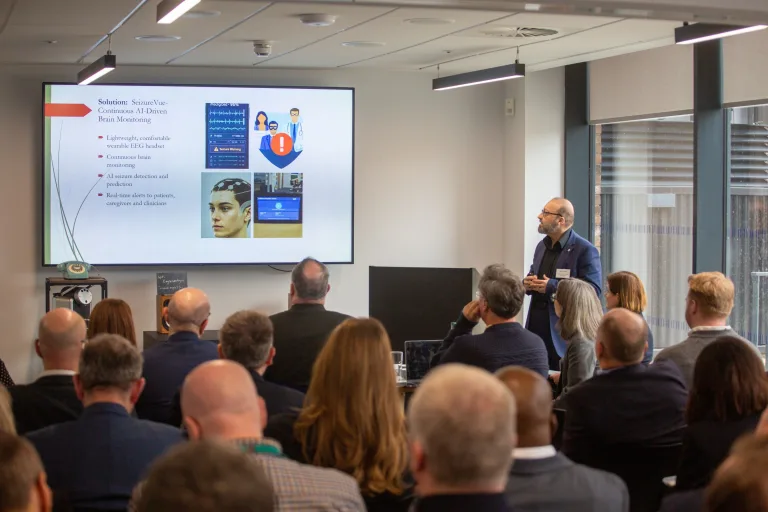
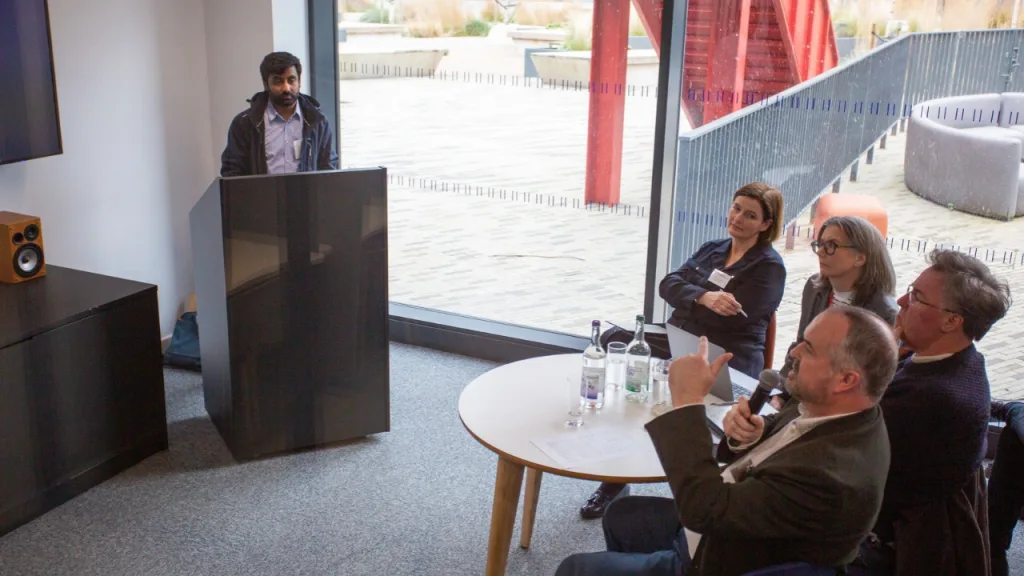
Professor Hadi Larijani presents SeizureVue to the investor panel at the Glasgow City Region Kickstart Innovation showcase.
From proven programmes to national infrastructure
The opportunity now is to embed this approach across the UK's innovation ecosystem, not just one cohort at a time. That takes two things.
The first is consistent commercial capability development across large innovation portfolios, from early market validation through to international scale. The second is a shared, real-time visibility of how those portfolios are progressing.
The value is shared across the system rather than captured at one point in it:
- Founders build commercial capability earlier and more consistently, progressing faster from innovation to revenue and investment.
- Universities and TTOs get stronger spinouts aligned to investor expectations, with measurable commercialisation outcomes for REF and KEF.
- Public funders see better conversion from funding to revenue to investment, with real-time portfolio visibility to target support.
- Investors get a more consistent, de-risked and comparable pipeline, with less diligence friction on every deal.
Clusters, city-regions and nations multiply the impact of capital already committed, converting local research strength into revenue, jobs and follow-on investment anchored in-region.
Let's build the infrastructure together
To make this approach scalable, we've developed a tech infrastructure that enables commercial capability development and portfolio visibility to be delivered consistently across large innovation ecosystems. This delivers Kickstart and tracks every venture's progress in one place.
From the new year, we're partnering with organisations that manage innovation portfolios to bring their ventures into Kickstart on the platform, ahead of its wider launch in 2027. Pilot partners get a portfolio-wide view of each venture's commercial capability, investment readiness and economic outcomes over time, so they can target support where it counts and evidence their impact.
Get in touch
If you're a programme director, investment lead or place-based economic development lead, let's talk. And if you're at the ScaleUp Institute Annual Review on 9 November, come and find me.
Recent Insights
Supercharge your inbox
Subscribe to our emails for the latest insights and updates